Introduction
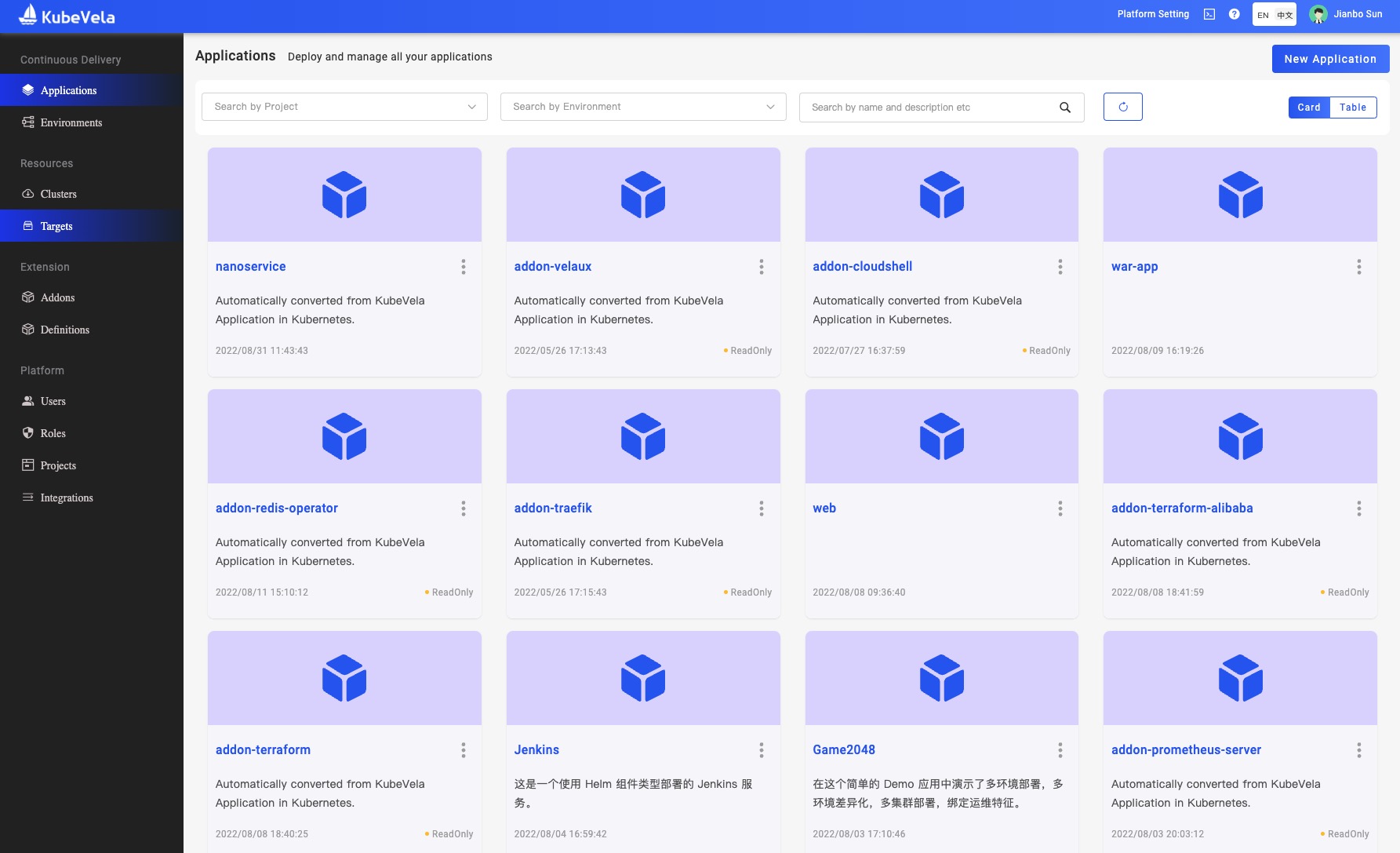
VelaUX is the web console for KubeVela. It gives the people who ship applications a place to create them, deploy them to their environments, watch them run and roll them back, without writing Application YAML or running vela themselves. Platform teams get users, projects, roles and single sign-on on top, so one KubeVela install can serve many teams.
These pages describe VelaUX 1.9.5, the version the velaux addon installs.
Who it's for
| You are | VelaUX gives you |
|---|---|
| An application developer | A form for each component type, one-click deploys per environment, the workflow as it runs, logs, pods and revisions to roll back to. |
| A platform engineer | Projects to keep teams apart, delivery targets that pin where each environment deploys, addons and definitions managed from one page, and UI schemas to shape the forms your definitions get. |
| A CI pipeline | A webhook per application (a trigger) to redeploy on a new image, and the REST API behind every screen. |
How it relates to KubeVela
VelaUX is an addon. It runs as one server in vela-system beside the KubeVela controller, and it never deploys anything itself: what you build in the console becomes a KubeVela Application, and the controller does the rest.
- VelaUX keeps its own records of projects, environments, targets, users and applications. By default they are stored in the cluster itself (
dbType=kubeapi); see Install options for a database. - Each environment an application is bound to becomes one
Applicationin the environment's namespace. Deploying runs that Application's workflow. - Applications you create with
velaorkubectlshow up too. VelaUX syncs them into a project, so the console and the CLI can work side by side. - The forms come from the definitions. VelaUX builds each component, trait and workflow step form from the definition's parameter schema, so a new definition gets a form without any VelaUX change.
What 1.9.5 doesn't cover
VelaUX 1.9.5 predates KubeVela 1.12. It doesn't show sources or modules, has no UI for the ConfigTemplate CRD, ignores the +ui parameter markers, and can't edit a config Secret that 1.12 adopted. Everything else works with KubeVela 1.12; see Versions.
Next steps
- Install VelaUX, then follow the Quick Start to deploy your first application from it.
- Concepts explains projects, environments, delivery targets and the application lifecycle.