KubeVela ResourceTracker Pattern: How Self-Healing Works Without Watching Every Resource

Every Kubernetes operator answers the same question whenever a child resource changes: "which parent should I reconcile?" The usual answer is controller-runtime's .Owns() helper, which registers an Informer per child type, caches them, and reads the OwnerReference on each child to find its parent. That's fine when you know your child types up front. It stops being fine when your operator is a platform engine and users keep inventing new resource types.
KubeVela takes a different route. The Application controller doesn't watch Pods, Deployments, or Services at all. It watches three KubeVela CRDs and keeps a separate record — the ResourceTracker — that lists everything an Application is supposed to have created. This post covers why the design exists, how self-healing works without event-driven watches on children, what you can tune, and how the approach compares to plain client-go and controller-runtime.
1. The Problem Space
A controller needs to know when its child resources are created, modified, or deleted. The standard way to get those notifications is to register an Informer per child type. That works fine when the set of child types is small and known. It doesn't work as well when your operator is a platform that can produce any resource type its users want.
Look at KubeVela's controller setup and you'll notice it doesn't watch Deployments, Services, or other rendered kinds. So how does it notice when a directly managed resource gets deleted and recreate it?
// Application controller setup — SetupWithManager
func (r *Reconciler) SetupWithManager(mgr ctrl.Manager) error {
    return ctrl.NewControllerManagedBy(mgr).
        Watches(
            &v1beta1.ResourceTracker{},
            ctrlHandler.EnqueueRequestsFromMapFunc(findObjectForResourceTracker)).
        WithOptions(controller.Options{
            MaxConcurrentReconciles: r.concurrentReconciles,
        }).
        WithEventFilter(predicate.Funcs{ /* ... */ }).
        Watches(
            &v1beta1.PolicyDefinition{},
            ctrlHandler.EnqueueRequestsFromMapFunc(r.handlePolicyDefinitionChange),
        ).
        For(&v1beta1.Application{}).
        Complete(r)
}
// Notice: NO .Owns(&corev1.Pod{}), NO .Owns(&appsv1.Deployment{})
KubeVela combines a ResourceTracker record with periodic reconciliation instead of watching child resources directly. The trade is real: you give up millisecond event-driven reaction and get back type-agnostic tracking over a fixed watch set.
The Traditional .Owns() Pattern
In a typical Kubebuilder controller, you register direct watches on every child resource type:
func (r *MyReconciler) SetupWithManager(mgr ctrl.Manager) error {
    return ctrl.NewControllerManagedBy(mgr).
        For(&v1beta1.MyApp{}).
        Owns(&corev1.Pod{}).           // Direct watch on Pods
        Owns(&appsv1.Deployment{}).    // Direct watch on Deployments
        Owns(&corev1.Service{}).       // Direct watch on Services
        Complete(r)
}
Each .Owns() call creates a dedicated Informer that:
- Opens a persistent watch stream to the API server for that type
- Caches every instance of that type cluster-wide in memory
- Fires create/update/delete handlers and reads the OwnerReference to find the parent
The Scaling Problem
This works well when you have 2–5 known child types. KubeVela is built for the opposite case — it has to handle dynamic, user-defined workloads. A single Application can produce:
Standard Kubernetes resources
- Pods, Deployments, StatefulSets
- Services, Ingresses
- ConfigMaps, Secrets
- PVCs, ServiceAccounts
- Jobs, CronJobs
Third-party CRDs
- Prometheus ServiceMonitors
- Istio VirtualServices
- Cert-Manager Certificates
- Crossplane AWS / GCP resources
- User-defined custom trait CRDs
.Owns() at scaleIf an Application can produce 100 different resource types, you need 100 .Owns() lines. Each one creates a separate Informer that caches every instance of that type in the cluster. With 10,000 Pods running, the Pod Informer holds all 10,000 in memory, even if only 50 of them belong to your controller.
And you can't enumerate the types up front anyway. Users keep adding new CRDs through CUE definitions, and .Owns() requires a controller restart for each new type.
2. The ResourceTracker Pattern
Architecture
The ResourceTracker is a cluster-scoped custom resource that holds a list of what an Application directly dispatched. The Application controller reads it to know what's supposed to be in the target clusters.
Application (your CR)
    │ creates & owns
    ▼
ResourceTracker (tracking metadata)
    │ records references to
    ▼
[ Pod, Deployment, Service, ConfigMap, Ingress, CRD X, … ]
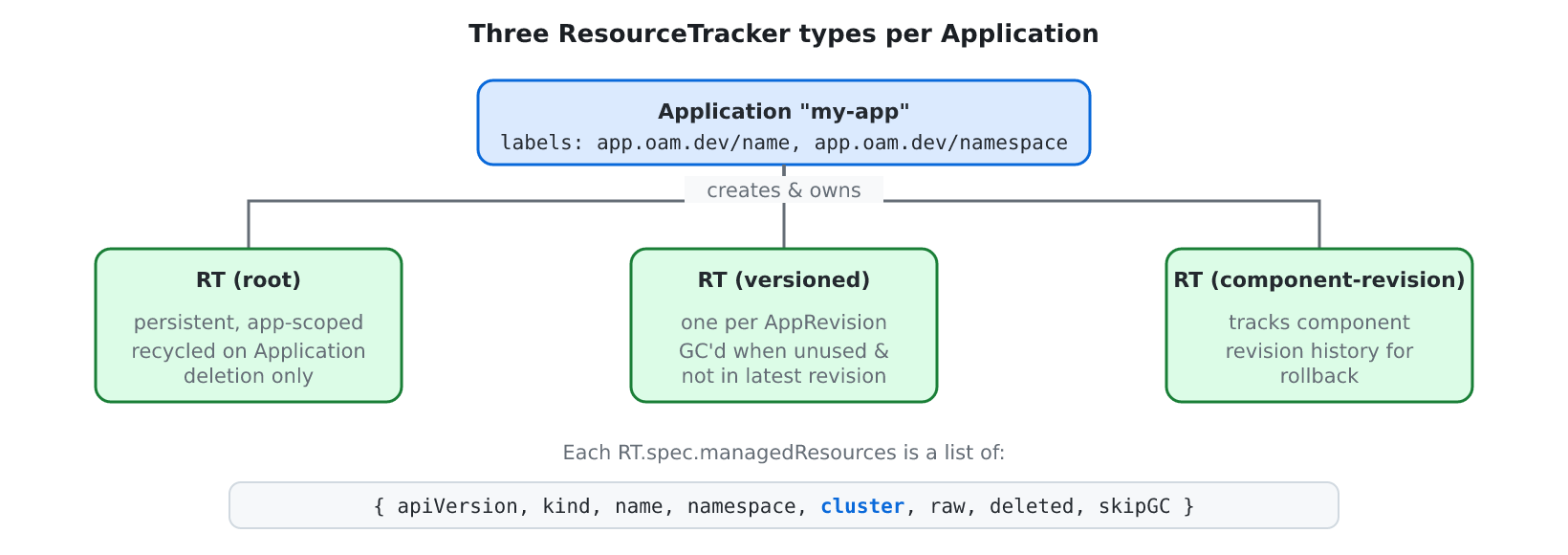
Figure 2 — The three RT types each handle a different lifecycle. The cluster field on every entry is what enables multicluster references without OwnerReferences (a namespaced Application can't own a cluster-scoped ResourceTracker anyway, so the arrow is a logical relationship, not a Kubernetes OwnerReference).
The Application controller watches three KubeVela CRDs: Application, ResourceTracker, and PolicyDefinition. The last one is there so that policy schema changes invalidate the cached renders. It does not watch Pods, Deployments, Services, or any other rendered child. Three watch sources for this controller, no matter what users create.
ResourceTracker Types
KubeVela uses three ResourceTracker variants, each tied to a different lifecycle:
| Type | Purpose | Lifecycle |
|---|---|---|
root | Resources that persist across upgrades | Recycled only when Application is deleted |
versioned | Version-specific resources for rollback | Recycled when version is unused and not in latest RT |
component-revision | Stores component revision history | Tracks all component revisions used |
This split lets KubeVela do version-aware garbage collection: clean up resources from old revisions while keeping the root ones alive, and keep component revision history around for rollback. None of it requires watching a single managed child.
ManagedResource struct
type ManagedResource struct {
    common.ClusterObjectReference `json:",inline"`  // apiVersion, kind, name, namespace, cluster
    common.OAMObjectReference     `json:",inline"`  // component, trait info
    Data    *runtime.RawExtension   `json:"raw,omitempty"`     // rendered manifest, when stored
    Deleted bool                    `json:"deleted,omitempty"` // marks for deletion
    SkipGC  bool                    `json:"skipGC,omitempty"`  // skip garbage collection
}
Each ManagedResource carries enough to identify the resource, and usually stores the rendered manifest in Data so it can be recreated. Data is absent for metadata-only entries. The Deleted flag marks an entry for removal: StateKeep issues the delete in the same pass and prunes the entry afterward.
Because the rendered spec is in Data, self-healing doesn't have to re-run CUE template rendering. The controller can Apply() the stored manifest directly. That keeps the self-healing path independent of the rendering pipeline, which matters when one of those is broken and the other isn't. Entries stored without Data are metadata-only and StateKeep skips them.
3. Self-Healing Mechanism
With no Informer for a directly managed kind, the controller has nothing to react to when one gets deleted. So it doesn't react. It comes back on a timer and runs StateKeep. This is eventual consistency, and it's a real departure from the event-driven model most operators use.
Periodic reconciliation
After each successful reconcile the controller requeues the Application for the next pass:
func (r *reconcileResult) ret() (ctrl.Result, error) {
    if r.Duration.Seconds() != 0 {
        return ctrl.Result{RequeueAfter: r.Duration}, r.err
    } else if r.err != nil {
        return ctrl.Result{}, r.err
    }
    return ctrl.Result{RequeueAfter: common2.ApplicationReSyncPeriod}, nil
}
// ApplicationReSyncPeriod re-sync period to reconcile application
ApplicationReSyncPeriod = time.Minute * 5
The default is 5 minutes, not 30 seconds (some older docs say 30s; that's wrong for current versions). It's a deliberate choice: with thousands of Applications in a cluster, a 30s cadence would hammer the API server. Five minutes gives you reasonable detection latency without that cost. If you need faster recovery for things like Pod restarts, you already have it — Kubernetes' built-in ReplicaSet controller handles Pod recreation in seconds. KubeVela's StateKeep path is for directly tracked resources such as the Deployment itself.
Health check pipeline
Each reconcile pass also evaluates component health:
// Simplified health evaluation flow
func evalStatus(ctx, handler, appFile, appParser) bool {
    healthCheck := handler.checkComponentHealth(appParser, appFile)

    if !hasHealthCheckPolicy(appFile.ParsedPolicies) {
        applyComponentHealthToServices(ctx, handler, componentMap, healthCheck)
        handler.app.Status.Services = handler.services
        return isHealthy(handler.services)
    }
    return true
}
Health evaluation is separate from StateKeep. StateKeep reads the current and root ResourceTrackers and passes each eligible stored manifest to KubeVela's applicator. The applicator creates a missing object or computes a client-side three-way patch for an existing one; it skips the write when the patch is empty. This is not Kubernetes server-side apply.
4. Tuning the ResourceTracker Reconcile Window
The 5-minute default from Section 3 isn't a fixed property of the system. The period is a flag. You can shorten it when drift recovery has to be fast, lengthen it when you have a lot of Applications and want to spare the API server, or leave it alone, which is the right answer most of the time. This section walks through the flag, the cost of moving it in either direction, and a few related flags people confuse with it.
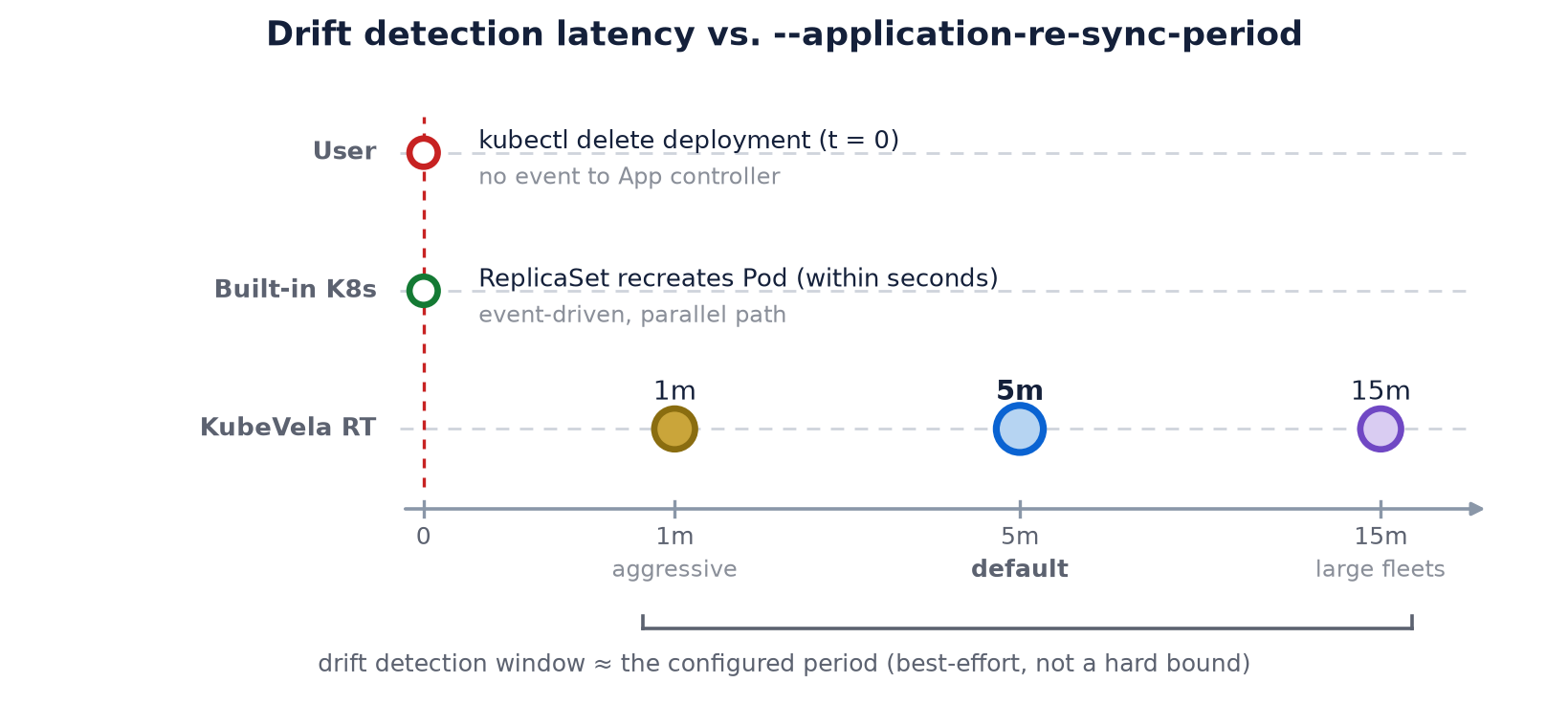
Figure 1 — Each marker is one possible value of --application-re-sync-period. The detection window is roughly the configured period, but it's best-effort, not a hard bound: queueing, client throttling, failed reconciles, and controller downtime can all push detection later. Deleting a Pod is a separate path, handled by its ReplicaSet in seconds. Spacing is for clarity, not linear time.
The flag — --application-re-sync-period
The flag takes a Go time.Duration string (30s, 1m, 15m, …) and defaults to 5m. Set it globally through the binary or Helm chart. An individual Application can override it with the app.oam.dev/reconcile-interval annotation; invalid values or durations below 10s fall back to the global value.
Direct CLI
vela-core --application-re-sync-period=1m
Helm chart override (charts/vela-core/values.yaml)
controllerArgs:
  reSyncPeriod: 1m
Trade-offs
On every StateKeep cycle, the controller reads tracked resources and calls the applicator for eligible entries that contain Data. The applicator skips the write when its computed patch is empty. The period is the divisor on this recurring work.
| Direction | What you gain | What you pay |
|---|---|---|
Shorter (e.g. 1m) | Faster recovery from higher-level drift — deleted Deployments, missing ConfigMaps, removed Services, mutated Ingresses. | API server reads scale roughly as Σ tracked resources / period. With 500 Apps × 8 resources × 60s period that is ~67 StateKeep reads/sec. Status updates and patches stack on top. |
Default (5m) | Balanced for typical fleets up to ~1000 Applications. | Recovery normally waits for a scheduled reconcile and can take longer than 5 minutes when delayed. Pod-level recovery remains with Kubernetes' built-in controllers. |
Longer (e.g. 15m) | Lower steady-state API server pressure on large fleets. Frees headroom to raise --concurrent-reconciles for spec-change throughput without overloading etcd. | A deleted Service, ConfigMap or Ingress normally stays missing for that window and possibly longer. Acceptable when lower-level controllers handle pod recovery. |
Companion knobs
These flags all interact in this area. Keep them straight before changing anything:
| Flag | Default | What it controls |
|---|---|---|
--application-re-sync-period | 5m | Period between RT re-evaluation cycles. This is the one you usually want. Helm: controllerArgs.reSyncPeriod. |
--concurrent-reconciles | 4 | Worker count for the Application controller. Raise this if shortening the period creates a queue backlog. Helm: concurrentReconciles. |
--informer-sync-period | 10h | Informer handler-resync interval. Not the RT reconcile loop, and not a guaranteed full API re-list. Almost never worth touching. |
--kube-api-qps | 50 (binary) | QPS limit on the controller's API client. The Helm chart ships 400. If you raise --concurrent-reconciles, raise this too or you will hit client-side throttling silently. |
--kube-api-burst | 100 (binary) | Burst limit on the API client. The Helm chart ships 600. Bump it alongside --kube-api-qps. |
Tuning recipes
Starting points, not benchmarks. Profile after any change. The right setting depends on resources per Application, custom traits, controller-runtime version, and how busy the rest of your control plane is.
| Cluster profile | re-sync period | concurrent-reconciles | kube-api-qps / burst |
|---|---|---|---|
| Dev / small (<100 Apps), drift-sensitive | 1m | 4 (default) | 50 / 100 (defaults) |
| Production / typical (100–1000 Apps) | 5m (default) | 4–8 | 50–100 / 100–200 |
| Large fleet (1000–10k Apps) | 10m–15m | 16–32 | 200–400 / 400–800 |
| Edge / quiet workloads, very high stability | 30m+ | 4 | 50 / 100 (defaults) |
Before shortening the period, check whether the drift you care about actually needs it. Pod restarts, CrashLoopBackOff recovery, Deployment scale-up — Kubernetes handles all of that in seconds without help from the RT loop. The RT period only matters when something deletes or modifies a resource directly tracked for the Application.
If your postmortem says "we lost a ConfigMap and didn't notice for five minutes", a shorter period helps. If it says "a Pod CrashLooped", the period is irrelevant and you should be looking at probes, resource limits, or the image instead.
5. Complete Flow: Deletion to Recreation
Walk through what happens when someone manually deletes a Deployment that KubeVela directly dispatched.
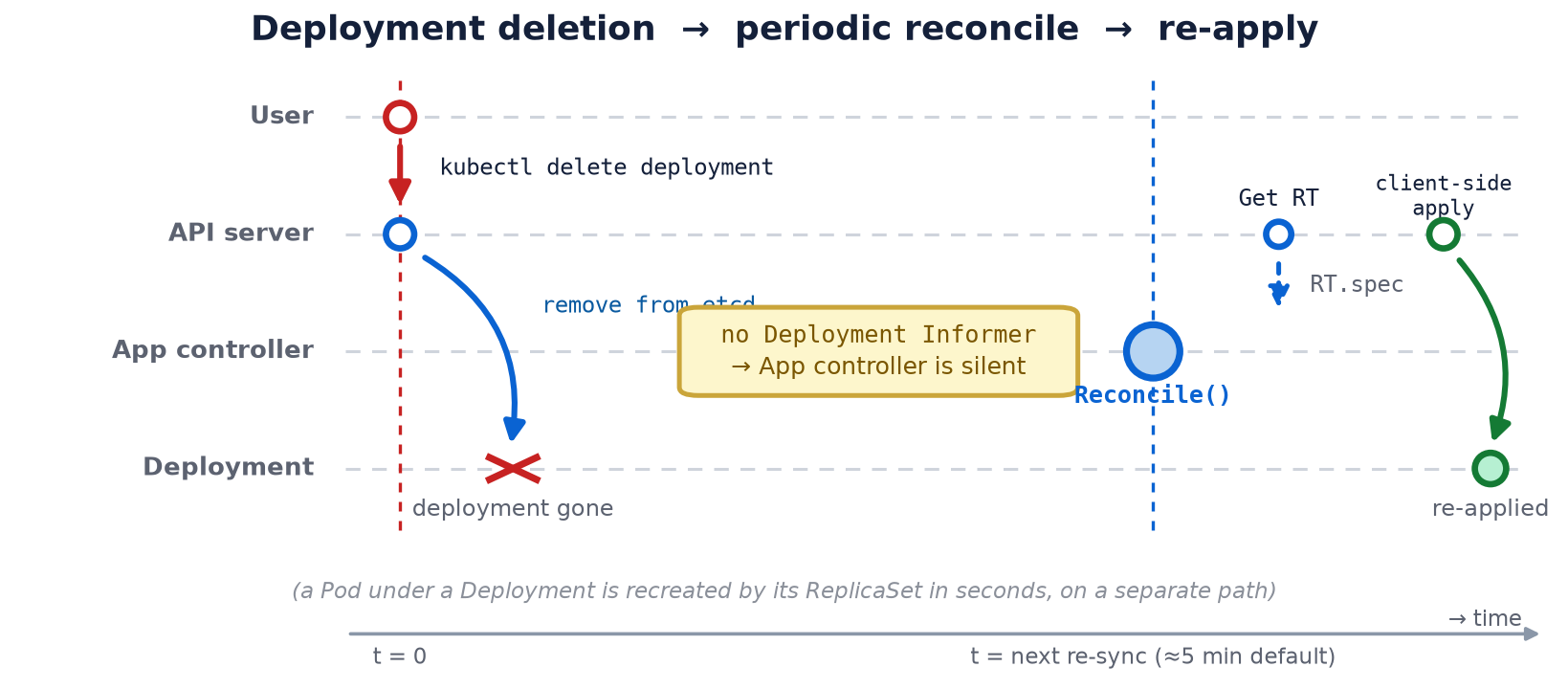
Figure 3 — The App controller hears nothing when the Deployment is deleted, because it runs no Deployment Informer. It notices on the next re-sync and re-applies the stored manifest with a client-side three-way patch. The 5-minute mark is the default period, not a guaranteed ceiling: queueing or controller downtime can push it out.
Step 1: Deployment deletion
Someone runs kubectl delete deployment my-app. The API server removes the Deployment. The Application controller hears nothing about it because there is no Deployment Informer. A Pod would be recreated by its ReplicaSet and is not the directly tracked resource in this example.
Step 2: Periodic reconciliation becomes eligible
The re-sync timer eventually goes off. Reconcile(ctx, Request{Name: "my-app"}) runs, and the work queue hands the Application to a worker. Queueing or controller downtime can extend the delay beyond the configured period.
Step 3: ResourceTracker lookup
The reconciler reads the Application CR and its current and root ResourceTrackers. Entries with Data carry the rendered manifest; metadata-only entries are not reapplied.
Step 4: StateKeep and apply
For each eligible stored manifest, StateKeep calls the applicator:
h.applicator.Apply(applyCtx, manifest, applyOptions...)
If the resource is gone, the applicator creates it. Otherwise it computes a client-side three-way patch and skips an empty patch.
Step 5: Recreation & requeue
Anything missing or drifted gets re-applied, the Application status is rewritten, and the controller schedules the next pass:
return ctrl.Result{RequeueAfter: 5 * time.Minute}, nil
RequeueAfter schedules later work; it is not an upper-bound latency guarantee.
KubeVela's self-healing rides on top of Kubernetes' built-in controllers, not in place of them. Delete a Pod under a Deployment and the ReplicaSet controller has it back in seconds. The 5-minute KubeVela loop is for the layer above that: deleted Deployments, modified Services, missing ConfigMaps, whole resource graphs that need to come back.
6. Event Filtering: Preventing Infinite Loops
Any controller that updates its own status during reconciliation can loop on itself: the status write fires an event, the event triggers another reconcile, that reconcile writes status again. KubeVela's Application controller is more exposed to this than most. A single pass can update workflow progress, health results, and the applied-resource list, each one a separate write.
The fix is event predicates: filters that decide whether an update event is worth reacting to. The rule is simple: only reconcile when a human (or some external system) changed the spec, or when the periodic timer fires. The predicate normalizes the controller's own status writes (workflow steps, applied resources, services) and then compares what's left, so a pass that only touched those fields is dropped.
| What changed? | Decision | Why |
|---|---|---|
User edited the spec (generation incremented) | ✓ Reconcile | User intent — always honor |
| Periodic re-sync (old == new) | ✓ Reconcile | Health check trigger |
| Workflow steps, applied resources, services | ✗ Skip | Controller's own writes, normalized out before comparison |
managedFields or resourceVersion only | ✗ Skip | API server bookkeeping |
The ResourceTracker has the same loop risk: the controller updates it on every reconcile to record newly applied resources. The chosen fix is aggressive — by default, RT events only enqueue a reconcile when the tracker is being deleted. Create and update events are dropped on the floor.
This works because the controller already reconciles Applications on a timer. It doesn't need RT update events to know when to look at things. The only RT event that matters is deletion, which means GC is in progress and the owning Application needs to respond.
7. .Watches() vs .Owns()
controller-runtime gives you two ways to watch related resources. The difference is what makes KubeVela's design possible.
.Owns()
- Automatically maps child → parent via OwnerReference
- Requires the child to have an
ownerReferencesentry pointing to the parent - One Informer per child type
- Cannot work cross-namespace (OwnerRef requires same namespace for namespaced owners)
- Cannot work cross-cluster
.Watches()
- Requires a custom mapping function (
EnqueueRequestsFromMapFunc) - Can use any logic to map source → target (labels, annotations, any field)
- Only watches the source type you specify
- Can map across namespaces
- Can map across clusters (with a custom client)
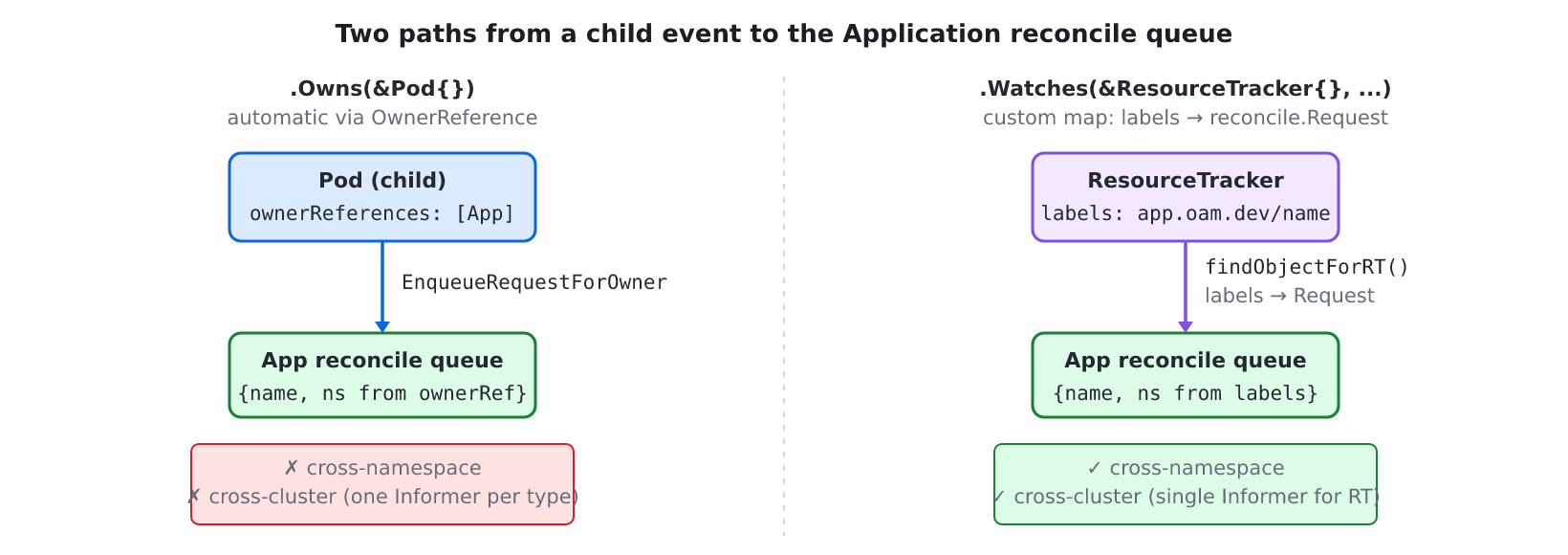
Figure 4 — .Owns() reads OwnerReferences from each child type's Informer. .Watches() reads ResourceTracker labels through the custom MapFunc findObjectForResourceTracker. Note the delete-only optimization below: routine healing rides the periodic reconcile, not this event path.
findObjectForResourceTracker
func findObjectForResourceTracker(_ context.Context, rt client.Object) []reconcile.Request {
    // Optimization: only trigger on RT deletion
    if EnableResourceTrackerDeleteOnlyTrigger && rt.GetDeletionTimestamp() == nil {
        return nil
    }
    if labels := rt.GetLabels(); labels != nil {
        var request reconcile.Request
        request.Name = labels[oam.LabelAppName]
        request.Namespace = labels[oam.LabelAppNamespace]
        if request.Namespace != "" && request.Name != "" {
            return []reconcile.Request{request}
        }
    }
    return nil
}
Instead of reading the OwnerReference from a child's metadata, this function reads labels off the ResourceTracker (app.oam.dev/name, app.oam.dev/namespace) to find the owning Application. That breaks the dependency on Kubernetes' ownership model, which is what makes cross-namespace references possible. Cross-cluster is a separate mechanism: it comes from the cluster field in ClusterObjectReference and KubeVela's multicluster client, not from .Watches() alone.
8. Pattern Comparison
| Aspect | Traditional .Owns() | KubeVela ResourceTracker |
|---|---|---|
| Informers needed | One per child type (O(n)) | Three total (O(1)) |
| Memory cache | All instances of each watched type | Applications, ResourceTrackers, and PolicyDefinitions, plus tracker payload that grows with the managed resources |
| Detection latency | Milliseconds (event-driven) | Periodic (default 5 min), not a hard bound |
| New CRD support | Requires code change + controller restart | Automatic, no changes needed |
| Cross-namespace | ✗ Not supported (OwnerRef requires same namespace) | ✓ Supported via label-based mapping |
| Cross-cluster | ✗ Not supported | ✓ Supported (ClusterObjectReference) |
| API server watch streams | One per resource type | Three total |
| Garbage collection | Kubernetes built-in (cascading delete via OwnerRef) | Custom GC with versioned tracking and two-phase delete |
| Rollback support | Not built-in | Versioned ResourceTrackers enable revision history |
| Implementation complexity | Simple (1 line per type) | Significant (custom CRD, GC logic, health pipeline) |
9. Why KubeVela Chose This Design
The ResourceTracker pattern isn't there for performance. It comes out of a few architectural calls:
1. Type agnosticism
KubeVela's whole pitch is that users write workloads as CUE templates (ComponentDefinitions, TraitDefinitions), and those templates can render any Kubernetes resource type. The controller can't know its child types at compile time. .Owns() requires every type to be registered up front. Those two facts don't fit together.
2. Multicluster resource management
KubeVela ships workloads across multiple clusters through the cluster gateway. OwnerReferences are single-cluster only — they identify the parent by UID, and UIDs are cluster-scoped. ResourceTracker uses ClusterObjectReference, which carries a cluster field, so it can track resources across cluster boundaries.
3. Version-aware lifecycle management
Versioned ResourceTrackers record which resources belonged to a given Application version, keyed on its generation or an explicit app.oam.dev/publishVersion. That gets you:
- Rollback: point the Application back at an older publish version and its ResourceTracker brings that exact resource set back.
- Safe GC: old versioned RTs are kept around as history. Their resources are only garbage collected once a newer RT has taken responsibility for managing them.
4. Separation of concerns
The ResourceTracker draws a line between the rendering pipeline (CUE evaluation, resource generation) and the dispatch pipeline (apply, track, self-heal). Dispatch records the rendered manifests in the tracker before applying them. StateKeep reads them back later. Neither has to know how the other works.
5. Bounded resource consumption
With 100 CRD types and 50,000 resources in a cluster, the .Owns() approach would cache all 50,000 across 100 Informers just to route child events. KubeVela's Application controller adds no Informer per rendered type, so it avoids that cache entirely. Memory still isn't constant, though: ResourceTracker count and payload grow with the number of Applications, their retained versions, and the manifests stored in Data.
There are real costs:
- Recovery waits for periodic reconciliation and can exceed the configured period
- API server load from periodic GETs against every tracked resource
- Custom GC logic instead of Kubernetes' built-in cascading delete
- The controller has to handle stale RT data without breaking
For a platform engine that manages dynamic, user-defined workloads across clusters, these are the right costs to take on. For a single-cluster operator with five known child types, they aren't.
10. OwnerReference Handling: client-go vs controller-runtime
To see what the ResourceTracker pattern is replacing, it helps to look at the standard approach. Every controller has to answer one question when a child changes: which parent should I reconcile? The ecosystem has three answers at three levels of abstraction.
The ownership problem
When a Deployment is deleted, the controller that owns it has to find out. Kubernetes doesn't automatically tell "whoever created this resource". The controller has to:
- Watch the child resource type (set up an Informer)
- Receive the deletion event
- Map the child back to its parent (find who owns it)
- Enqueue the parent for reconciliation
Step 3 uses the OwnerReference: a field in the child's metadata that points back to the parent.
# Every child resource carries a pointer to its parent
apiVersion: apps/v1
kind: Deployment
metadata:
  name: my-app-deployment
  ownerReferences:
    - apiVersion: mygroup.io/v1
      kind: MyApp                # parent type
      name: my-app               # parent name
      controller: true           # "I am the controller owner"
      uid: abc-123               # parent UID
How much of this you write yourself depends on which level of abstraction you pick.
Level 1: Raw client-go (maximum control)
Kubernetes' own sample-controller uses client-go directly. You assemble every piece of the pipeline yourself.
For each child type you want to watch:
- Create a
SharedInformerFactoryand pull out the typed Informer - Register three event handlers (Add, Update, Delete)
- In each handler, extract the OwnerReference from the child
- Check that the owner is your specific CRD Kind
- Look up the parent through a Lister
- Enqueue the parent's key into the work queue
Cost: roughly 100 lines per child type. Three child types work out to about nine handler functions and around 300 lines.
You also build the OwnerReference yourself when creating each child. Every field (apiVersion, kind, name, uid, controller: true) is yours to get right.
Level 2: controller-runtime .Owns() (automated wiring)
controller-runtime, used by Kubebuilder and Operator SDK, folds the whole client-go pipeline into one method call:
func (r *MyReconciler) SetupWithManager(mgr ctrl.Manager) error {
    return ctrl.NewControllerManagedBy(mgr).
        For(&myv1.MyApp{}).
        Owns(&appsv1.Deployment{}).   // this one line replaces ~100 lines of client-go
        Owns(&corev1.Service{}).
        Owns(&corev1.ConfigMap{}).
        Complete(r)
}
What .Owns() does behind the scenes
| Step | client-go (you write it) | .Owns() (generated) |
|---|---|---|
| Create Informer | NewSharedInformerFactory + typed getter | Auto-created from the GVK |
| Register handlers | AddEventHandler with 3 functions | Uses built-in EnqueueRequestForOwner |
| Extract OwnerRef | GetControllerOf + Kind check | Automatic: matches Kind + APIVersion + controller flag |
| Enqueue parent | workqueue.Add(key) | Returns reconcile.Request automatically |
| Set OwnerRef on create | Build OwnerReferences array manually | One-liner: ctrl.SetControllerReference() |
Watching three child types drops from ~300 lines (client-go) to 3 lines (controller-runtime). For operators with a known, fixed set of child types, this is the right answer.
Level 3: KubeVela ResourceTracker (type-agnostic)
Both client-go and controller-runtime share one assumption: you know your child types at compile time. Each type has to be registered explicitly. The cost differs (100 lines vs 1 line per type), but the assumption is the same.
KubeVela drops the assumption:
// KubeVela's entire watch setup — handles ANY managed resource type
ctrl.NewControllerManagedBy(mgr).
    For(&v1beta1.Application{}).
    Watches(&v1beta1.ResourceTracker{}, ...).
    Watches(&v1beta1.PolicyDefinition{}, ...).
    Complete(r)
// Three Informers total: Application, ResourceTracker, PolicyDefinition.
// None of them is a managed child. Handles Deployments, Services,
// Istio VirtualServices, Crossplane RDS instances, user-defined CRDs.
// Anything, dynamically, with zero .Owns() calls.
Instead of registering a watch per type, the ResourceTracker records what got dispatched. Instead of an OwnerReference-driven event mapping, the controller revisits tracked resources on a timer to see whether they still exist. The ownership model moves from "embedded in the child" to "written down in a separate record".
The abstraction spectrum
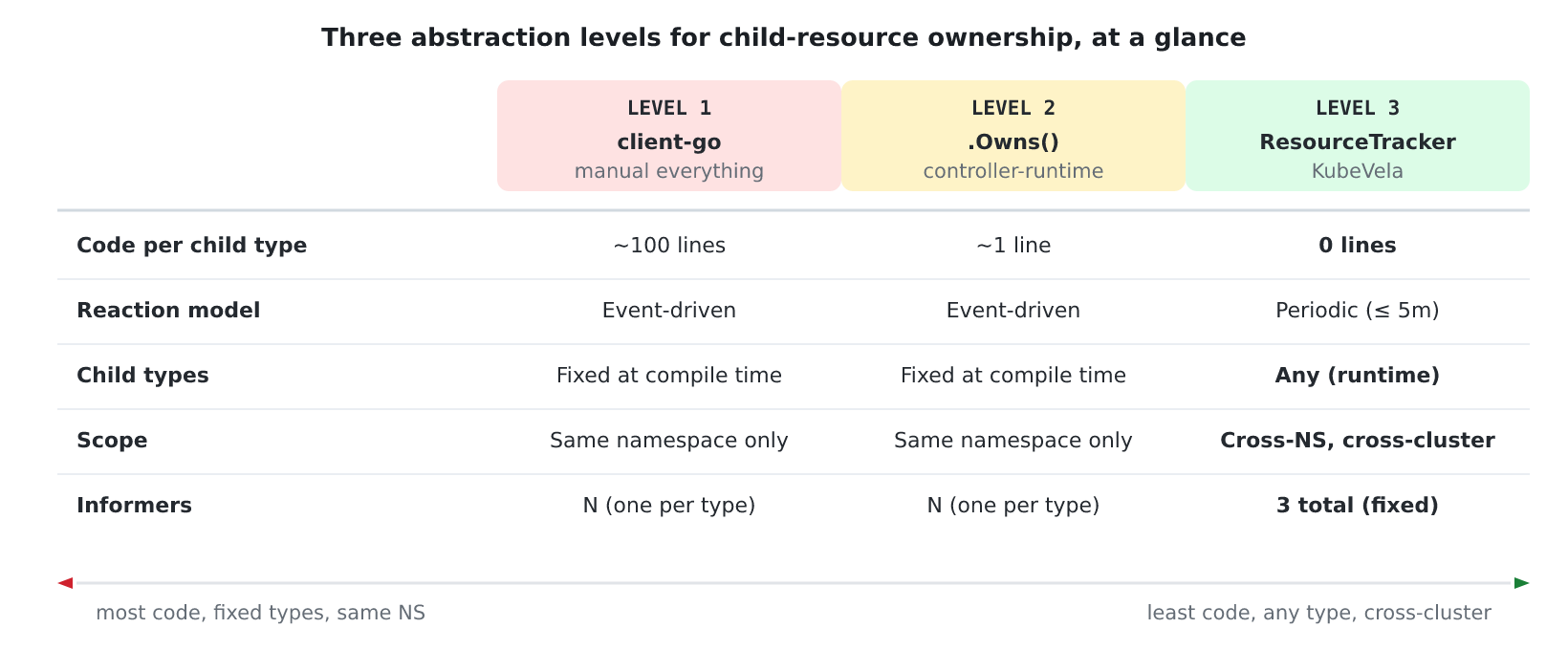
Figure 5 — Levels 1 and 2 differ in code size, not capability. Level 3 is the only one that breaks the same-namespace, fixed-types ceiling. Color coding: red is a constraint, amber is a caveat, green is unrestricted.
Each level trades simplicity for flexibility:
- client-go — reach for it when you need event handling that controller-runtime's abstractions can't express. This is rare.
- controller-runtime
.Owns()— the right answer for almost every operator. If you know your child types and they live in the same namespace, this is where you start. - ResourceTracker pattern — use it when you're building a platform that manages user-defined resource types across namespaces or clusters. The added complexity only pays off when
.Owns()literally cannot do the job.
11. Choosing Your Pattern
Use .Owns() when:
- You manage 2–10 known resource types
- All resources live in the same namespace
- It's a single-cluster operator
- You need immediate event-driven self-healing
- You want Kubernetes' built-in cascading delete
- Simplicity matters more than scale
Consider ResourceTracker when:
- You manage unknown or user-defined resource types
- Resources span multiple namespaces or clusters
- The set of resource types is large or unbounded
- You need version-aware tracking and rollback
- Memory at scale is a real constraint
- Eventual consistency in the seconds-to-minutes range is acceptable
ResourceTracker isn't a replacement for .Owns(). It solves a different problem. Traditional operators know their child types when registering watches. Platform engines like KubeVela don't. If you're writing a small operator, use .Owns(). If you're writing a platform that manages dynamic, user-defined workloads across cluster boundaries, the ResourceTracker pattern is worth studying as one way to do type-agnostic self-healing with a fixed managed-kind watch set.
12. Case Study: Crossplane RBAC Manager OOMs at Scale
Up to here the argument has been theoretical: unbounded watches make controller memory grow with cluster size. Here's a production failure where that growth crossed the memory limit, and a look at why the same failure mode can't happen to KubeVela's Application controller.
The incident measurements below need a primary incident citation. Upstream source verifies the watch, cache, and list behavior, not the reported OOM counts or memory figures.
What happened
A team running Crossplane across a fleet of clusters hit a confusing problem. The crossplane-rbac-manager pod was crash-looping on one cluster but running fine on every other cluster from the same Helm release. Same image, same providers, same arguments, same 2 GiB memory limit. Over 13 days the affected pod logged:
- 56
OOMKilledevents (exit code 137), roughly four per day - Each crash hit within about 20 seconds of pod start, during initial informer cache sync
- Re-kills were observed near the controller's hourly
SyncPeriod; that setting requests resync events and does not itself guarantee a full API re-list
In the windows where the pod stayed up, steady-state memory was around 293 MiB, less than a seventh of the limit. So this wasn't a slow leak burning down to the limit. The pod ran comfortably for hours, then died in a single sub-minute spike.
What looked like a leak wasn't one. By every Crossplane-internal number the controller was fine. It was managing about 36 ProviderRevisions and 680 ClusterRoles, both well inside the design envelope. The thing that was actually driving memory growth was outside Crossplane's own resource graph, and none of those metrics caught it.
The only real difference between the broken cluster and the healthy ones was the total Deployment count:
| Cluster | Total Deployments | RBAC manager status |
|---|---|---|
| Affected cluster | 6,073 | OOMKilled, 56 restarts in 13 days |
| All sister clusters | < 600 | Healthy, zero restarts |
Roughly 10× the Deployment density. Nothing else differed.
The cause
The RBAC manager's binding controller (internal/controller/rbac/provider/binding/reconciler.go) sets up its watches like this:
return ctrl.NewControllerManagedBy(mgr).
    Named(name).
    For(&v1.ProviderRevision{}).
    Owns(&rbacv1.ClusterRoleBinding{}).
    Watches(&appsv1.Deployment{},
        handler.EnqueueRequestForOwner(mgr.GetScheme(), mgr.GetRESTMapper(), &v1.ProviderRevision{})).
    WithOptions(o.ForControllerRuntime()).
    Complete(errors.WithSilentRequeueOnConflict(r))
EnqueueRequestForOwner filters which Deployment events get turned into reconcile requests — only Deployments owned by a ProviderRevision enqueue work. That part is fine. The problem is what happens before the handler runs.
Watches(&appsv1.Deployment{}, ...) registers an informer on Deployments. The informer's cache is what holds the objects, and there is no namespace filter, no field selector, and no cache.ByObject constraint anywhere in the manager setup. Every Deployment in the cluster, regardless of who owns it, gets materialized in the controller's informer cache. The handler-level owner filter narrows the event path; it does not narrow the cache path. Cache cost is O(cluster Deployment count), not O(Crossplane-managed resources).
In the reported incident, the cache fit inside 2 GiB at roughly 600 Deployments and the working set crossed the limit at 6,073. The source confirms the unfiltered cache and list path, but proving that path caused the measured spike requires incident evidence such as heap profiles.
Why KubeVela's watch shape is different
The KubeVela Application controller doesn't watch Deployment at all. Its SetupWithManager registers three builder sources (Application, ResourceTracker, PolicyDefinition), and that set is fixed no matter what users build on top of it. Unstructured managed-resource reads bypass KubeVela's local cache by default unless a GVK is explicitly opted in.
Unrelated Deployments therefore do not enter this controller's Deployment cache. Memory still grows with Applications, ResourceTrackers, retained versions, and stored manifest payloads.
| Crossplane RBAC manager | KubeVela Application controller | |
|---|---|---|
Watches Deployment | Yes (unfiltered, cluster-wide) | No |
| Relevant cache footprint scales with | Deployments visible to the manager | Applications and tracker count/payload |
| Effect of unrelated Deployments | They enter the Deployment cache | They do not enter this controller's Deployment cache |
| 6,000 Deployments outcome | OOMKilled in the reported incident | Not established by source |
| Mitigation needed | Cache selectors or other measured tuning | Different trade-off: tracker storage and periodic API work |
The lesson
Any controller that uses .Owns() or unfiltered .Watches() cluster-wide on a high-cardinality type inherits that visible inventory as a cache cost. The handler's owner filter does not filter the cache. In the reported incident, the watch set stayed under the limit at small scale and exceeded it at large scale.
The ResourceTracker pattern removes rendered managed kinds from this controller's watch set and replaces direct watching with record-and-reconcile. That avoids this specific cache shape. It is not free: the cost shifts to ResourceTracker storage and periodic API work.
References
- KubeVela source (audited at
a59bd39): github.com/kubevela/kubevela - Application controller:
pkg/controller/core.oam.dev/v1beta1/application/application_controller.go - ResourceTracker types:
apis/core.oam.dev/v1beta1/resourcetracker_types.go - Kubernetes sample-controller: github.com/kubernetes/sample-controller
- controller-runtime: github.com/kubernetes-sigs/controller-runtime
- Crossplane RBAC manager: binding reconciler, cache configuration